
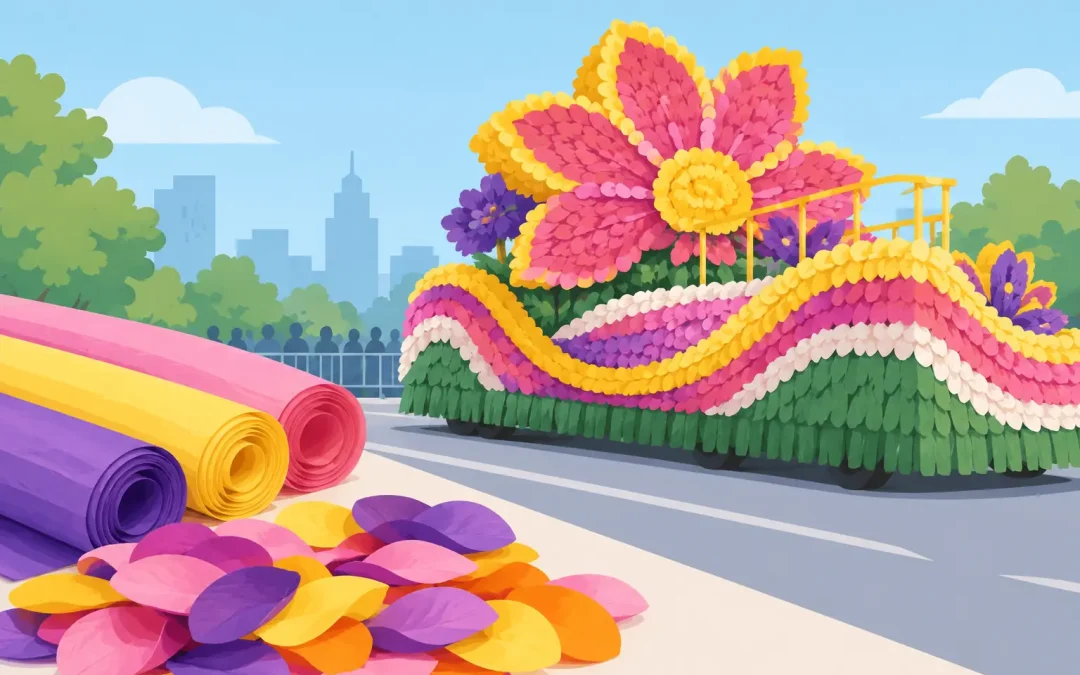
A parade float can have a great idea, sturdy construction, and a hardworking group of volunteers behind it, but exposed plywood, chicken wire, and plain trailer sides still look unfinished from the curb. So, what is petal paper? It is a textured decorative covering, also called floral sheeting, made to give floats a full, flower-like surface of color without placing thousands of individual flowers by hand.
For parade builders, petal paper is one of the most practical ways to turn a frame into a finished float. It covers a lot of space quickly, photographs well, and gives even simple shapes the kind of texture that catches the eye as the float moves down the street.
What Is Petal Paper Used for on a Float?
Petal paper is commonly used as the main background covering for parade floats. Its surface is filled with small, closely layered petals that create a soft, dimensional floral appearance. From a viewing distance, it reads as a rich blanket of color rather than a flat sheet of material.
Builders use it to cover trailer skirting, float platforms, walls, arches, boxes, signs, and large themed structures. It is especially useful when the design calls for a field of solid color, such as a red fire truck, a green shamrock setting, a white winter scene, or a school float in team colors.
The value is not just color. Petal paper helps hide the practical parts of float construction: staples, seams, wire, foam, lumber, and uneven surfaces. That matters because parade spectators are looking at the overall picture, not the hours of framing and fastening that made the design possible.
Petal Paper vs. Flat Paper and Individual Flowers
Flat rolls of paper can cover a surface, but they usually show every wrinkle and do not have much visual depth. Petal paper has texture built in. Light catches the individual petals, helping a covered surface look fuller and more festive under daylight, streetlights, or camera flashes.
Individual artificial flowers can create a beautiful effect, particularly around focal points or lettering. The trade-off is time and cost. Covering an entire float with individual flowers requires a lot of pieces and a lot of hands. Petal paper delivers a similar floral impression across large areas much faster.
That does not mean petal paper is the right material for every detail. It works best as a broad covering or background. If you are making a giant sunflower, a royal crown, a mascot face, or a detailed holiday centerpiece, you may want to combine petal paper with fringe, festoon, deco puffs, glitter, or shaped floral accents. The strongest float designs often use petal paper as the foundation, then add contrast where people will notice it most.
Why Texture Matters Along a Parade Route
Parades are viewed in motion. People may see your float for only a few seconds, often from across a street. Fine details can disappear, but color blocks and texture remain visible.
A textured covering makes a float look more finished at that distance. It also gives volunteers a forgiving material to work with. Small staple lines, slight overlaps, and minor irregularities are generally much less noticeable in a petal-covered surface than on a smooth background.
Choosing the Right Colors for Your Design
Start with the message or theme, then choose colors that can be recognized quickly. A patriotic float might use red, white, and blue sections. A church group may choose colors that coordinate with a seasonal message. A school or youth sports team can build the entire design around official team colors.
For most floats, two or three main colors are easier to read than a rainbow of equal-sized sections. Use one dominant color for the large background areas, then reserve contrasting colors for borders, lettering, props, and focal points. A dark background behind light letters, or a light background behind dark letters, is usually easier for spectators to read.
It is also wise to think about where the float will travel. Bright colors tend to perform well in daylight. White can look clean and striking, but it may need darker trim or bold lettering so it does not blend into a bright sky. Black makes a strong background for glitter, metallic accents, or bright floral colors, though it can absorb detail if the rest of the design is too dark.
Before ordering, look at your sketch from several feet away. If the colors and message are clear on paper, they have a better chance of being clear from the sidewalk.
How to Use Petal Paper on a Parade Float
A little preparation makes installation much easier. Build and test your framework first. Petal paper is a finish material, so it should go on after the structure is stable and any major mechanical or safety needs have been handled.
Measure every surface you plan to cover. For a rectangular side, multiply length by height. For curved forms, measure around the outside rather than relying on the straight-line width. Add extra material for overlaps, wrapped edges, mistakes, and last-minute repairs. Ordering too tightly can slow down a build when everyone is ready to decorate.
Attach the material from the bottom up when possible. This lets upper sections overlap lower sections, which helps conceal seams and gives the covering a cleaner look. Keep the petals facing outward, pull the backing smooth without stretching it too hard, and secure it at regular intervals with staples or another appropriate fastener for your float surface.
Avoid trying to cover every complicated curve with one large piece. On rounded props, smaller sections are often easier to control and less likely to bunch. Overlap the pieces in the direction that will be least visible to the crowd. If a seam will be noticeable, cover it with fringe, festoon, garland, a border color, or another decorative element.
A Simple Work Order That Saves Time
Many volunteer groups lose time because they begin decorating before deciding which areas need to be covered first. A better approach is to finish the large background surfaces, add skirting and borders, install major props, then add letters and small details.
This order keeps people from working around finished lettering or fragile accents. It also makes it easier to stand back, check the design, and fill any thin or unfinished-looking areas before the float leaves the work site.
Common Mistakes to Avoid
The most common mistake is treating petal paper like an afterthought. If it is your main covering, it needs to be part of the original material estimate and color plan. A mismatched replacement color or a shortage near parade day can change the look of the whole float.
Another mistake is covering over parts that need access. Leave clear openings for trailer connections, lighting controls, ladders, rider entrances, wheels, and any equipment that must be checked before the parade. Decorations should never interfere with safe operation, visibility for the driver, or local parade rules.
Builders also sometimes use the same texture everywhere. Petal paper creates fullness, but a float can look flat if every surface has the same color and finish. Add a border, contrasting trim, oversized flowers, glittered shapes, or dimensional lettering to give the eye a place to land.
Finally, do not wait until the last evening to test how the float looks outdoors. Pull it outside or view it under the lighting conditions you expect on parade day. What looks balanced inside a gym, garage, or school cafeteria can look very different in full sun.
How Much Petal Paper Do You Need?
The answer depends on the size and shape of the float, the width of the material, and how much overlap your design requires. Measure each area separately instead of estimating the entire float by trailer size alone. A float with tall side panels, a roofline, and several boxed props needs more covering than an open trailer of the same length.
For a first-time builder, it is better to allow a reasonable margin than to run short. Extra material is useful for patching corners, wrapping small props, hiding seams, and making matching accents. If you are building a large annual float or working from a detailed sketch, knowledgeable staff can help turn your measurements into a practical material estimate.
At ParadeFloatStuff.com, float builders can choose floral sheeting and matching parade decorations from a company that has been helping groups prepare for parade day since 1936. For time-sensitive projects, having the right color and enough material on hand is often the difference between a rushed finish and a float your group is proud to show off.
Petal paper will not build the frame or choose the theme for you, but it can make all that hard work look complete. Measure carefully, keep your color plan simple, and save your most detailed accents for the places spectators will remember.