
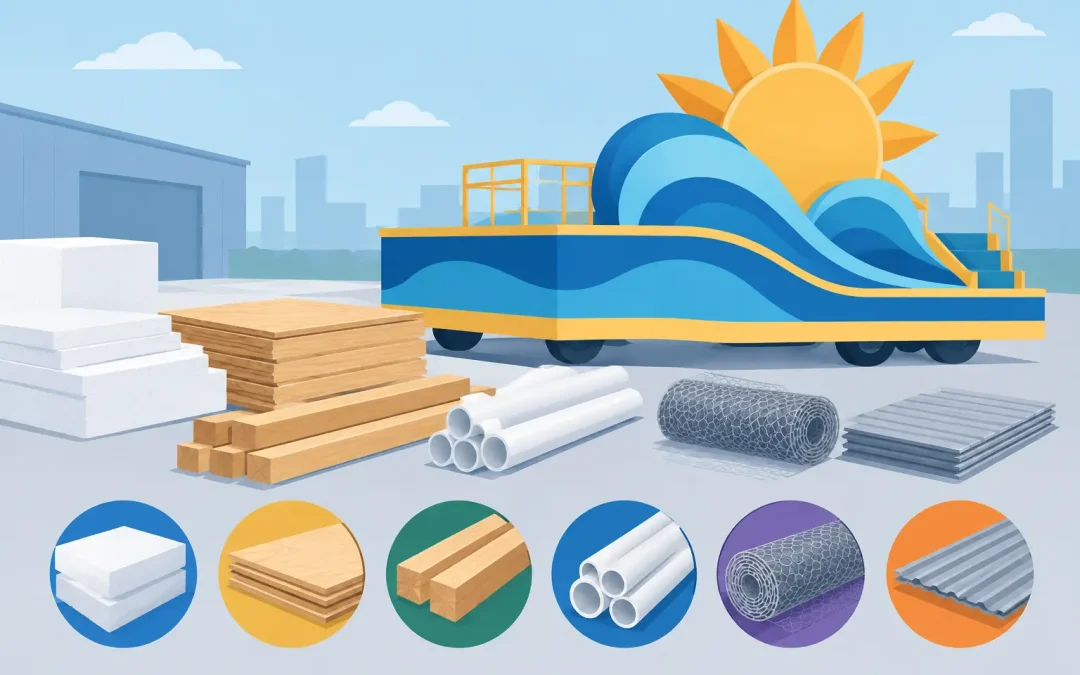
A float can have beautiful fringe, lettering, and color, but none of it matters if the structure underneath flexes, sags, or becomes difficult to decorate. Choosing the best parade float base materials starts with one practical question: are you building a safe structure, creating a smooth decorating surface, or doing both?
Those jobs often call for different materials. A trailer deck or truck bed needs strength. Float sides need a material that holds its shape and gives decorations something to attach to. Large props need to stay light enough for volunteers to handle and secure enough to make it down the parade route. Planning for each job separately usually saves money, time, and last-minute repairs.
Start With a Safe, Stable Foundation
Before adding a single flower or roll of fringe, inspect the vehicle or trailer you are using. A flatbed trailer, utility trailer, hay wagon, or pickup truck bed may already provide the structural floor you need. In that case, your base-material budget can focus on side panels, risers, and props rather than building an entire deck from scratch.
Keep the float’s total weight within the vehicle and trailer capacity. Weight matters more than many first-time builders expect, especially once you add lumber, people, large props, and decorations. Distribute weight evenly, keep heavy pieces low, and fasten the framework securely to the trailer. If your design includes tall structures, check local parade rules for height limits, clearance requirements, and rider safety.
For a simple community float, a basic wood frame attached to the existing deck is often the most dependable starting point. For a larger annual parade entry, build the frame with enough bracing to withstand turns, wind, potholes, and the occasional enthusiastic wave from the riders.
Best Parade Float Base Materials by Job
There is no single material that is best for every part of a float. The right choice depends on how much strength, weather resistance, and smooth coverage you need.
Plywood for strong floors, walls, and platforms
Plywood remains one of the most useful float-building materials because it is strong, easy to cut, and widely available. Exterior-grade plywood is a smart choice for floor extensions, side walls, raised platforms, and any panel that needs to support decorations or lightweight props.
A half-inch sheet works well for many vertical float sides when it is supported by a frame. Three-quarter-inch plywood is better for walking surfaces and areas carrying more weight. Plywood accepts staples, screws, nails, and adhesive well, making it easy to attach floral sheeting, plastic rolls, or fringe.
The trade-off is weight. A large plywood float can become heavy quickly, and untreated sheets can absorb moisture. Seal exposed edges if rain is possible, especially when the float will be built several days before the event.
OSB for a lower-cost structural option
Oriented strand board, often called OSB, can be a budget-friendly substitute for plywood when you need broad, flat panels. It works best for temporary walls, hidden structural areas, and dry-weather projects where appearance is not the priority.
OSB is generally less expensive, but it is rougher and more prone to swelling when wet. It can also be heavier than expected. If you plan to cover every inch with floral sheeting or plastic, that rough surface may not matter. If the board will show or the forecast looks wet, plywood is usually worth the extra cost.
Lumber for framing and dependable support
For the framework itself, standard dimensional lumber is the workhorse. Two-by-fours are a practical choice for vertical supports, perimeter frames, and bracing. One-by-twos and one-by-threes are useful for lighter prop frames and places where you need a staple surface without adding much weight.
Wood framing is familiar to most volunteer crews, and it allows easy changes when a design evolves. That flexibility is valuable when building a float in a school parking lot, church lot, or community center a few days before the parade. Use exterior screws rather than relying on nails alone, particularly for parts that may shake or shift during transport.
Rigid foam board for lightweight shapes
Rigid foam insulation board is one of the best choices for oversized letters, cartoon-style cutouts, clouds, waves, building fronts, and other shapes that do not need to carry weight. It is exceptionally light, easy to cut with the right tools, and simple to cover with floral sheeting, tissue, paint, or glitter.
Foam board is not a structural material. It can crack, dent, or catch the wind if it is not supported properly. Attach large foam pieces to a wood frame or backer panel, and avoid using it as a walking surface or freestanding wall. It is excellent for visual impact, not for load-bearing work.
Corrugated plastic for weather-resistant panels
Corrugated plastic sheets are a strong option for signs, lightweight walls, and flat decorative panels. They resist moisture better than wood products, weigh very little, and are easy to clean. Their smooth surface makes them particularly useful when you want a crisp sign background or a clean color block.
Because the material is hollow and flexible, it needs framing or support when used in large spans. Staples may not hold as reliably as they do in wood, so plan on using zip ties, screws with washers, or adhesive suited to plastic. Corrugated plastic is a good choice when rain is likely or when the float must be moved and stored before parade day.
Chicken wire for curved forms
Chicken wire, hardware cloth, and similar mesh materials help create rounded shapes that flat panels cannot. Use them for arches, hills, animal bodies, oversized ornaments, and sculpted scenery. A wood or PVC frame gives the mesh its basic shape, then the surface can be covered with paper, fabric, floral sheeting, or other decorations.
Mesh is light and flexible, but it has sharp edges. Wear gloves, fold or cover exposed ends, and keep wire away from riders. It is best used as a shaping material rather than the main foundation of the float.
Choose Materials Based on Your Float Design
A flat, decorated trailer may need only a wood frame around the edge, plywood side panels, and coverage materials. A float designed to look like a fire truck, castle, train, or storefront needs more framing and panels. A whimsical entry with large characters may rely more heavily on foam board, mesh, and lightweight prop supports.
For most groups, the best approach is a mixed-material build. Use lumber and plywood where strength is required. Use foam board and mesh where size matters but weight does not. Use corrugated plastic where weather resistance and clean signage matter. Trying to make one material do every job usually creates unnecessary weight, cost, or frustration.
It also helps to think about what will cover the base. Two-ply fringe and floral sheeting can hide a plain framework beautifully, but they need an attachment surface. Wood panels make stapling fast. Plastic surfaces may require tape, adhesive, or mechanical fasteners. Measure those coverage areas before ordering decorations so you are not stretching material or leaving bare spots near the bottom edge.
Don’t Forget Weather, Transport, and Teardown
A parade float is rarely built and displayed in the same place. It may be assembled in a garage, parked overnight, towed across town, staged on pavement, and exposed to wind or rain before the parade begins. Your materials need to survive that process.
If the forecast is uncertain, avoid relying on bare cardboard for exterior surfaces. Cardboard is inexpensive and useful for indoor signs or small protected props, but it softens quickly in damp conditions. Cover vulnerable wood edges, secure loose decorations, and keep a repair kit on hand with extra fasteners, tape, scissors, and matching decoration materials.
Build with teardown in mind, too. Screws make it easier to remove panels and reuse lumber. Foam shapes and corrugated plastic signs can often be stored for next year if they are labeled and kept dry. Reusing the structural parts of a float can make an annual parade project far more affordable.
Get the Base Right Before Decorating
The most attractive float coverings work best when the base is square, secure, and planned to fit the design. Measure the trailer, sketch the major walls and props, and decide where riders will stand before buying lumber or panels. Then calculate the decorating surface separately from the structural materials.
At ParadeFloatStuff.com, our knowledgeable staff has helped float builders work through measurements, coverage needs, and time-sensitive parade projects for decades. No order is too small when you need to finish a float that the whole community will see.
A well-built base does not have to be fancy. It just has to stay secure, carry the design, and give your volunteers a solid place to create something memorable.